Sats Well Spent
From nostr foundations to GitHub trending: what OpenSats grantees shipped in Q2, and how permissionless tech keeps opening new territory.
Dear Freedom Lovers,
We must build the world we wish to see.
This was the simple premise, the kernel of truth, our north star, that led us to will OpenSats into existence. An efficient, transparent, sustainable, and globally scalable nonprofit focused on accelerating freedom technology. Easier said than done.
The truth is that we were wildly naive on how difficult the task of building out this mission would be. And yet, here we are, distributing nearly a million dollars worth of bitcoin to hundreds of grant recipients in over forty countries every month. Our success is tangible but the mission remains a challenge, there is plenty of work left to be done.
We could not have accomplished what we have without your support. Thousands of people have donated. Thousands of builders have applied for grants. The work of our mostly volunteer team combining the two. We are focused on accelerating technology, but it is people, motivated individuals, that push this movement forward.
It should not be a surprise that our pain point is also people. There remains a shortage of qualified, responsible, trustworthy volunteers. Working on it. We have also had difficulty securing recurring financial support from both individuals and companies, many of which benefit from the open source software we support. Also working on it, but this aspect feels even more uphill. Raising money is hard. Feels like a treadmill. This is why a large base of recurring support is so important for our sustainable future. On the bright side, we hold all donations in bitcoin multisig, which provides us both sovereignty and purchasing power benefits.
Life is short, the grind is long, the mission is more important than ever. If you are reading this, do more, whether that is supporting our work at OpenSats or doing your own thing in parallel to accelerate freedom tech. We need it. Our children need it. The future is bright if we make it bright.
If not us, then who? If not now, then when?
Push forward.
Never stop.
— ODELL
In total, OpenSats has allocated $21,646,000 USD to free and open-source projects and sent ~24.6 billion sats to 252 grantees in 32+ countries.
Building the Base
Developing software is hard. Even with all the agentic tools that today's LLM-driven world has to offer, creating and maintaining reliable software is a difficult and strenuous task.
Any long-lasting endeavor requires a solid foundation, and Bitcoin is no exception. OpenSats' mission is to help provide funding so that said foundation can be built. From open hardware to nostr libraries for open and censorship-resistant communication, to base-layer privacy for bitcoin itself: OpenSats funds it all.
Whether bull or bear market, we are here to support the builders. Those who are working on making bitcoin and the internet more open, more resilient, and more sovereign for those who dare to empower themselves. People like Calvin Kim, who is working on client diversity and Utreexo, and recently joined our long-term support roster to continue this work.
The base of any project—any human endeavor—is people. Whether it's software or hardware, buildings or protocols. It is people who bring these things into existence, and it is people who improve and maintain them.
Spotlight: Stories Worth Telling
Grants and numbers tell one side of the story. The people are the other. As Odell put it above, it is motivated individuals who push this movement forward. This past quarter we sat down with a few of them for our developer spotlight series, long-form profiles of the builders behind the software you help fund.
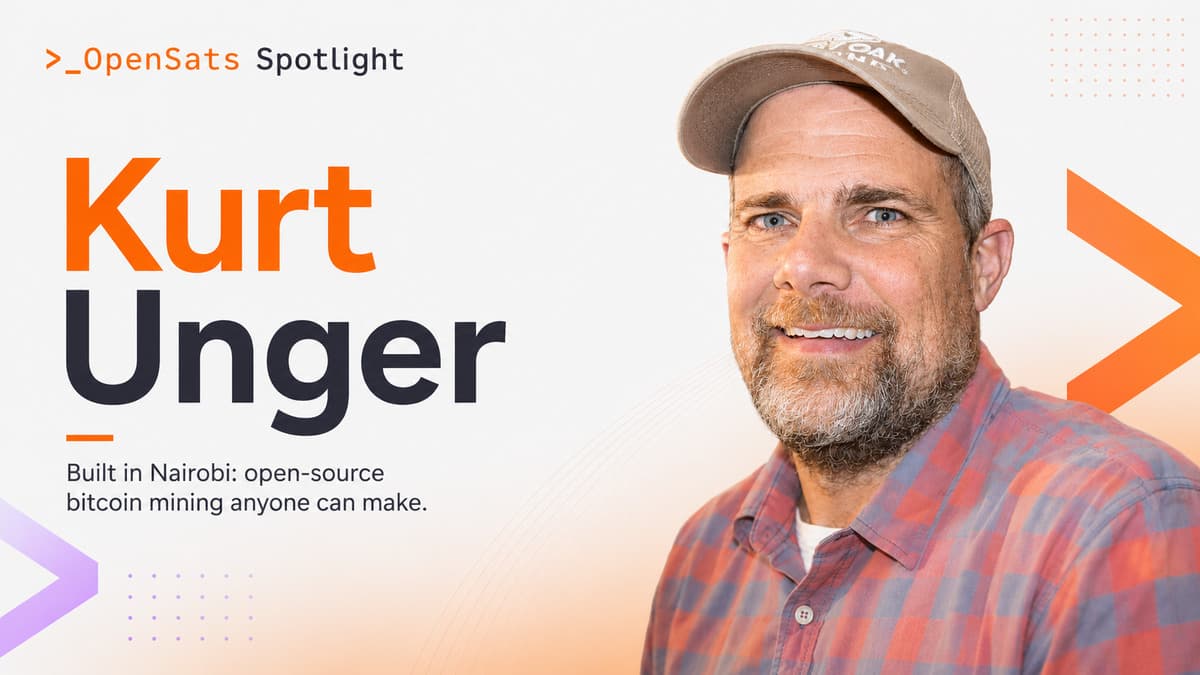
Seeing small communities thrive because they finally have stable, reliable power is deeply satisfying.
Kurt is building bitcoin mining hardware that is understandable, repairable, and open, drawing on more than a decade spent thinking about rural electrification.
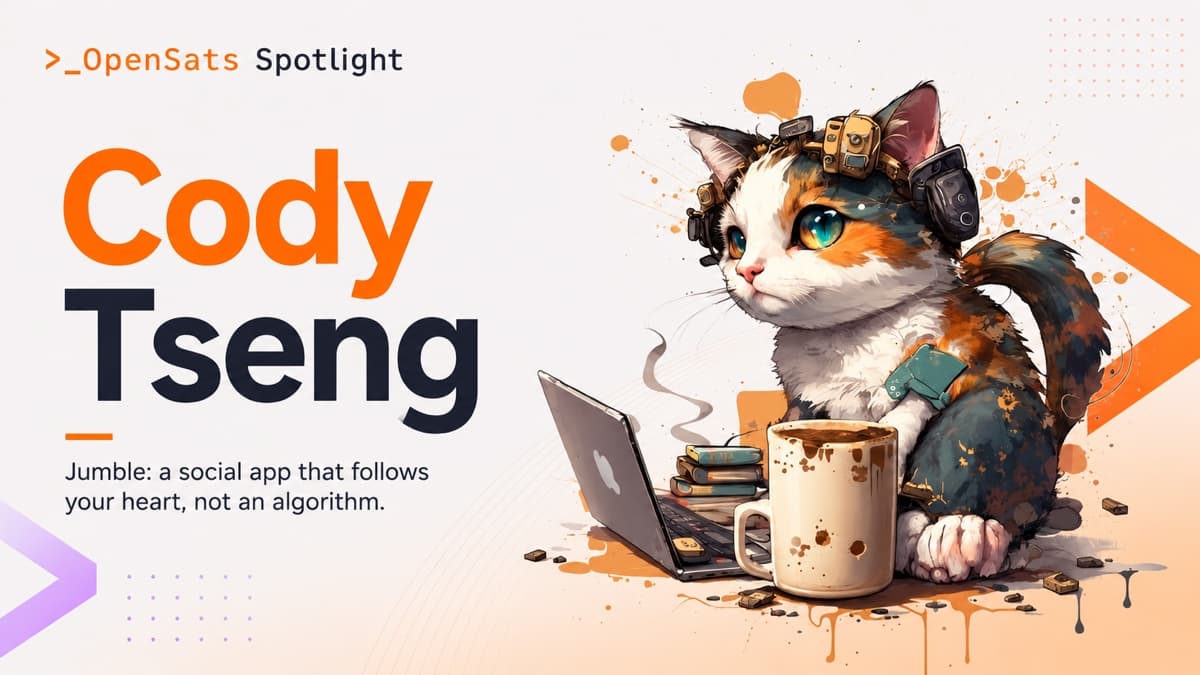
Like many people, I dislike being controlled and want to truly own certain things.
Cody builds Jumble, a nostr client for the open social web, on a single principle borrowed from his GitHub profile: follow your heart, not an algorithm.
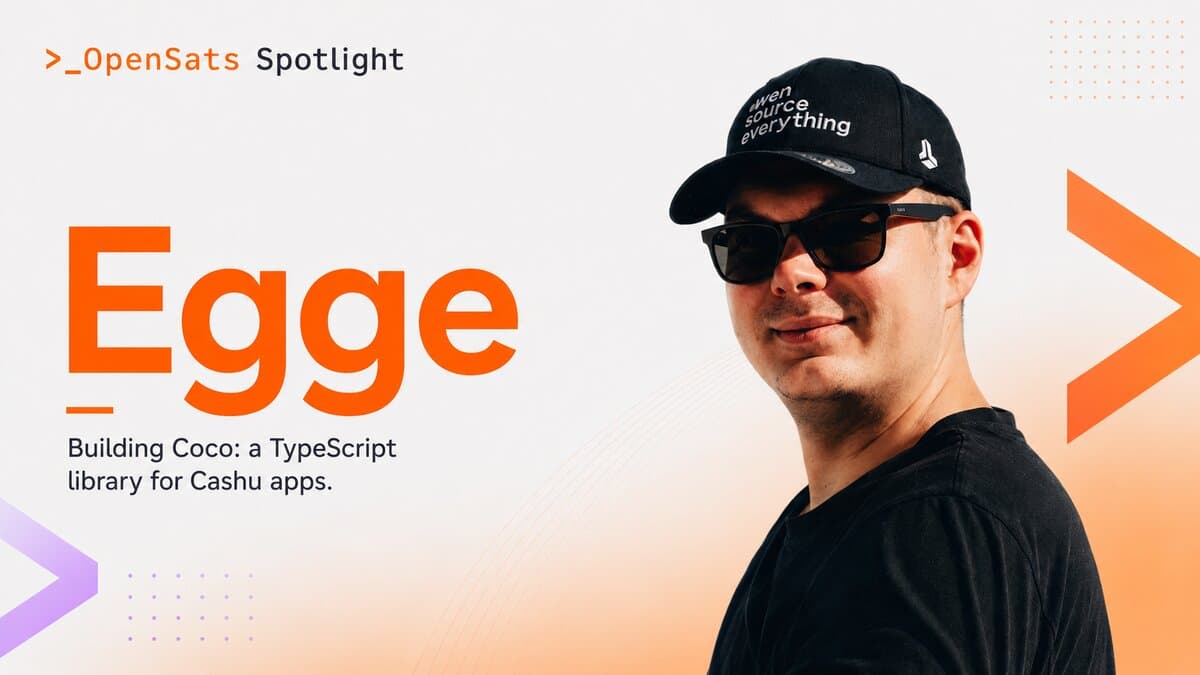
I believe you cannot dive really deep into Bitcoin without it changing or affecting you in some way.
Bitcoin took Egge off the predictable path and toward a career in FOSS, where he now builds open-source libraries used across the Cashu ecosystem.
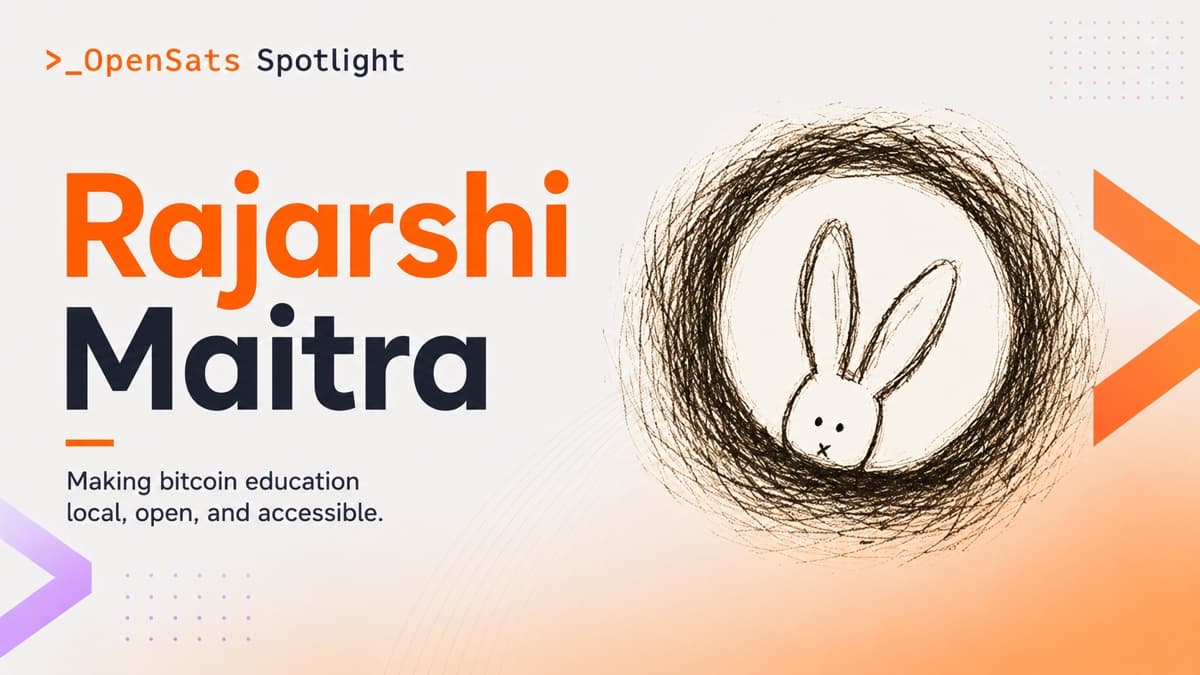
What Bitcoin did for me is like being that point of light in that dark cave.
Rajarshi walked away from a stable engineering career to build Bitshala, India's main bitcoin developer education organization.
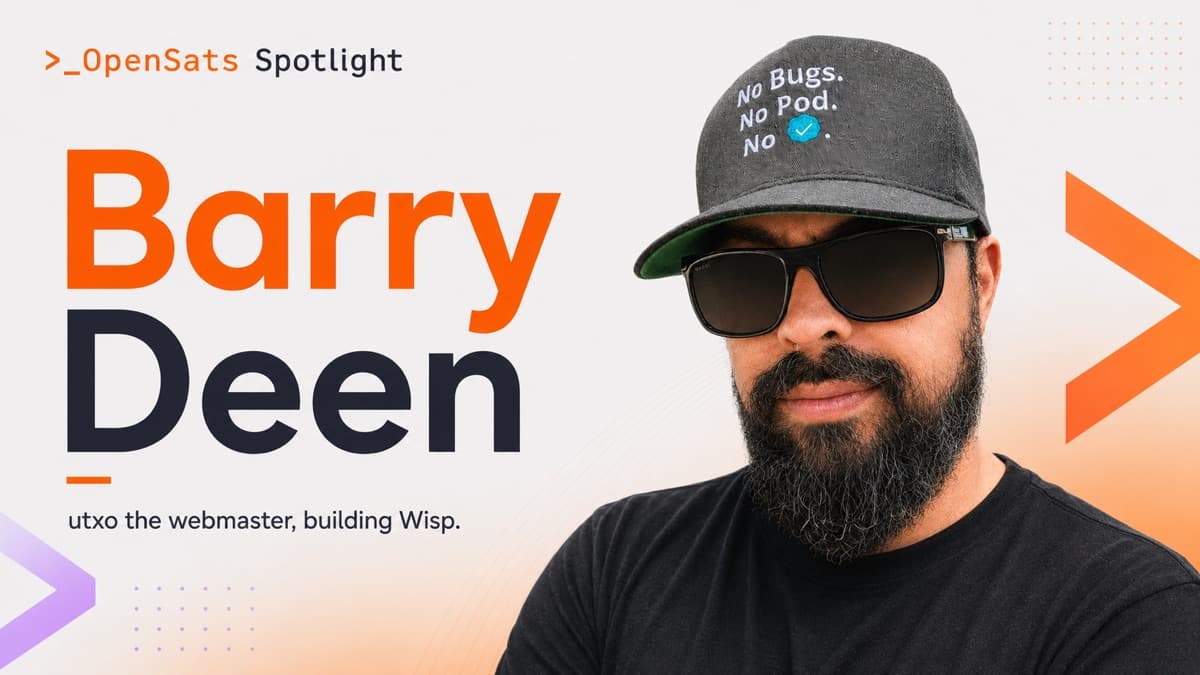
The biggest secret is just long hours, attention to detail, and hard work. Proof of work.
Barry, known online as UTXO the Webmaster, builds Wisp, a nostr client made for people who will never care what a protocol is.
Read the full series on our blog.
Sats Sent: 3,579,487,680
Lorem ipsum dolor sit amet, consectetur adipiscing elit. Duis aute irure dolor in reprehenderit in voluptate velit esse cillum dolore eu fugiat nulla pariatur.
Software Shipped
Our grantees shipped over 500 releases this quarter, spread across more than 90 of the hundreds of projects we support.
Some highlights:
- Splicing you can type: Core Lightning v26.04 added
spliceinandspliceoutcommands. Last quarter we wrote about LTS grantee Dusty Daemon getting splicing into the BOLTs. This quarter, node operators can resize a channel with a single command. The same release made payments more reliable through parallel pathfinding in askrene. - Cashu mints learn on-chain: CDK v0.17.0 implements NUT-30, which adds on-chain deposits and withdrawals to mints that previously spoke Lightning only.
- Floresta and utreexod: Floresta v0.9.0 implements the BIP-183 messaging flow for proof-driven sync, and utreexod v0.6.0 sped up historical proof generation. LTS grantee Calvin Kim leads the utreexod work.
- Krux patches what the robots found: v26.04.0 fixes a batch of security issues that AI-assisted audits surfaced in the hardware signer, including stricter PSBT checks and protections against malicious QR codes and SD cards.
- New firmware for the Bitaxe: ESP-Miner v2.14.0 gives the open-source home miner a customizable dashboard, a scoreboard, and logs that survive reboots.
There are too many releases to list, and they only tell one part of the story. Our grantees also write protocol specifications, do boring maintenance work, hunt for bugs, and build experimental prototypes of what might come next.
Some highlights:
- The LNHANCE Expedition's MCCV vault ("More Complicated CTV Vault") can now be tried on signet. This quarter brought a working CLI, persistent storage, and a user guide.
- Smite, the Lightning snapshot fuzzer we covered last issue, gained an IR-based fuzzing engine and
smitebot, a tool that automates long fuzzing campaigns. - Bitcoinfuzz added miniscript and descriptor modules and collected fresh trophies, among them a BIP32 seed length validation bug that affected several libraries.
- mosaico, from LTS grantee Pablo, is an experimental substrate for agent self-organization, similar in spirit to Block's buzz.
Have a look at the OpenSats heartbeat to get a live feed of every release, commit, and pull request across the projects we fund and have funded.
View HeartbeatIf you select our nostr fund, you'll see that this quarter brought new releases for Amber, Amethyst, Applesauce, Citrine, Coracle, Jumble, Mostro, nak, ngit, Wisp, ZapStore, and more. Wisp reached v1.0.0 this quarter and Citrine reached v3.0.0, both firsts for their projects.
From Foundation to Trending
Two of the foundational areas we support are cryptographic identities and permissionless communication protocols. Nostr provides solid fundamentals for both of these, allowing seamless communication and collaboration without intermediaries. The foundational work done by fiatjaf and our other nostr grantees is often strenuous and mostly invisible. Protocol-level work, relay implementations, boring cryptographic primitives.
It is all the more exciting, therefore, that two out of the three trending GitHub projects in the world are built on the foundations that OpenSats funds: buzz and bitchat.
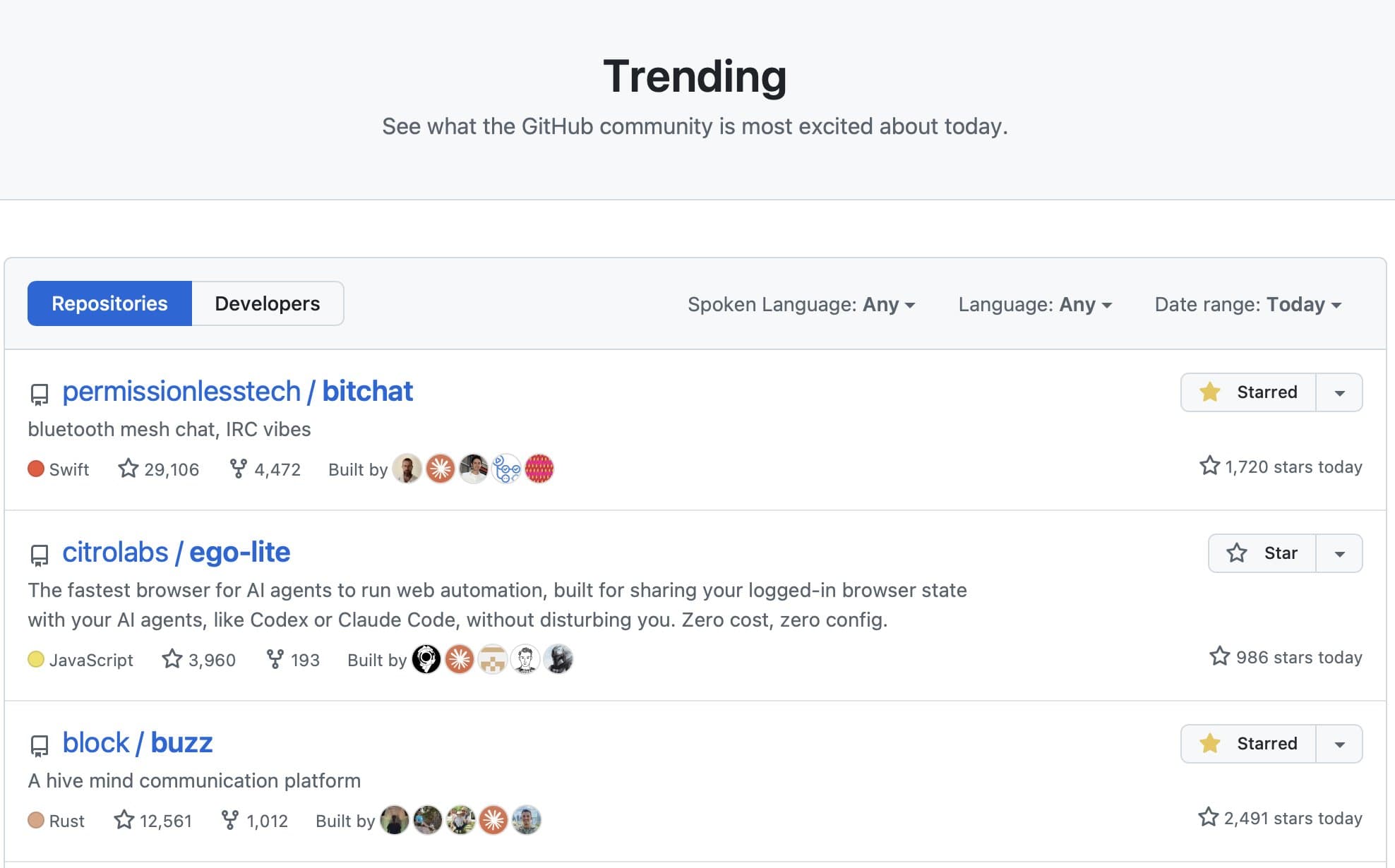
It is fantastic to see these projects gaining traction. A testament to the thesis that permissionless infrastructure and strong cryptographic primitives win out over walled gardens, no matter how pretty and convenient they might be.
Buzz relies on various nostr primitives we have funded. First and foremost NIP-29 group chats, but also various relay implementations and low-level protocol work done by fiatjaf and nostr protocol developers. Bitchat Android is built and maintained by Calle, one of our longest-running and most prolific LTS grantees.
A New Territory of Freedom
Permissionless protocols and the freedom tech that's built upon them open up a new territory. A territory for people to freely assemble, transact, communicate, and exchange ideas.
Satoshi Nakamoto was well aware of this when he started working on Bitcoin. He was also aware that authoritarian entities, those who love to control and silence others, will not be too happy about permissionless freedom tech. "Yes," he said in agreement, conceding the point that not all political problems can be addressed through cryptographic means, "but we can win a major battle in the arms race and gain a new territory of freedom for several years."
As permissionless technology proliferates, this new territory of freedom will continue to be attacked and subverted, by legal and other means. The most recent example is a takedown request by the Indian government sent to our LTS grantee Calle, regarding the aforementioned bitchat app.
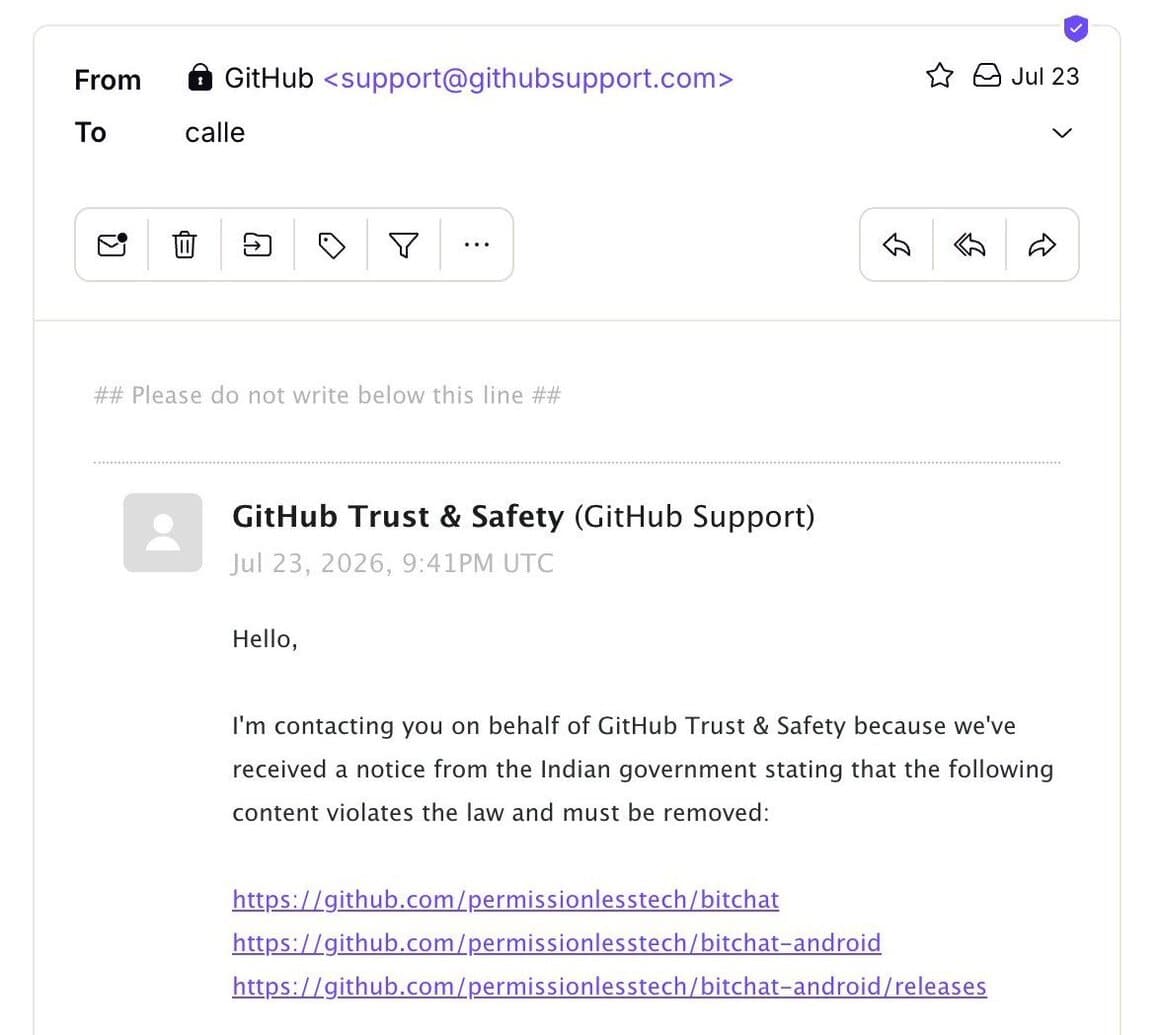
Allow me to quote Satoshi once more, in order to set up Calle's response to the government's takedown request: "It takes advantage of the nature of information being easy to spread but hard to stifle."
Easy to spread, hard to stifle. Such is the nature of information.
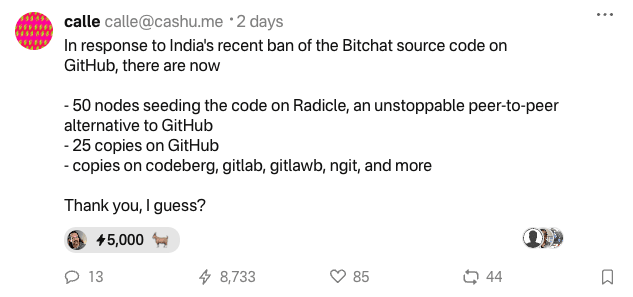
The bitchat source code is now mirrored across a multitude of censorship-resistant protocols, including the nostr-native ngit funded by OpenSats. And in addition to all of the above, bitchat can now send itself to another phone with no internet required.
In the words of the cypherpunks: code is speech, speech is information, and information is notoriously hard to stifle.
A New Home of Mind
As we're heading further into the agentic age, the age of machine intelligence, I can't help but think of the opening line of John Perry Barlow's A Declaration of the Independence of Cyberspace, written in 1996:
Governments of the Industrial World, you weary giants of flesh and steel, I come from Cyberspace, the new home of Mind.
Barlow wrote that "cyberspace consists of transactions, relationships, and thought itself," a construct that is created and made possible by the very act of communication between peers. He describes "a world that all may enter without privilege or prejudice accorded by race, economic power, military force, or station of birth." A world "where anyone, anywhere may express his or her beliefs, no matter how singular, without fear of being coerced into silence or conformity."
We have drifted quite far from this vision of the world. In part due to our own negligence, and in part due to the incentives and structures we've built around cyberspace primitives: closed platforms, quarterly profits, walled gardens, top-down access controls, and permissioned networks. The siren song of convenience distracted us from the more lofty ideals of liberty and prosperity. We got user acquisition but lost user freedoms in the process.
It is on us to create a new home for our minds that is worthy, welcoming, and wonderfully joyous to dwell in. We have to build the networks, the railroads, the proverbial information superhighways that allow us to assemble and communicate freely. Structures that are free and open, but also resilient, whether they are inhabited by minds made of flesh or minds made of silicon.
We have come a long way, but there's much that still needs to be built. As the doors of the legacy internet are closing—with age-verification checks, digital ID, proof-of-human, and similar measures that provide neither freedom nor safety—a new world is emerging.
OpenSats exists to fund the people who are building this world. We are grateful for the builders, and grateful for your support. We can't do it without you.
If you'd like the next issue delivered to your inbox, subscribe below.
Subscribe to our Newsletter
Quarterly updates on grantee highlights and the impact your support enables.
No spam. Unsubscribe anytime.